
The Plates are Still Waiting
Inquire to begin a conversation on pricing:
The Plates are Still Waiting
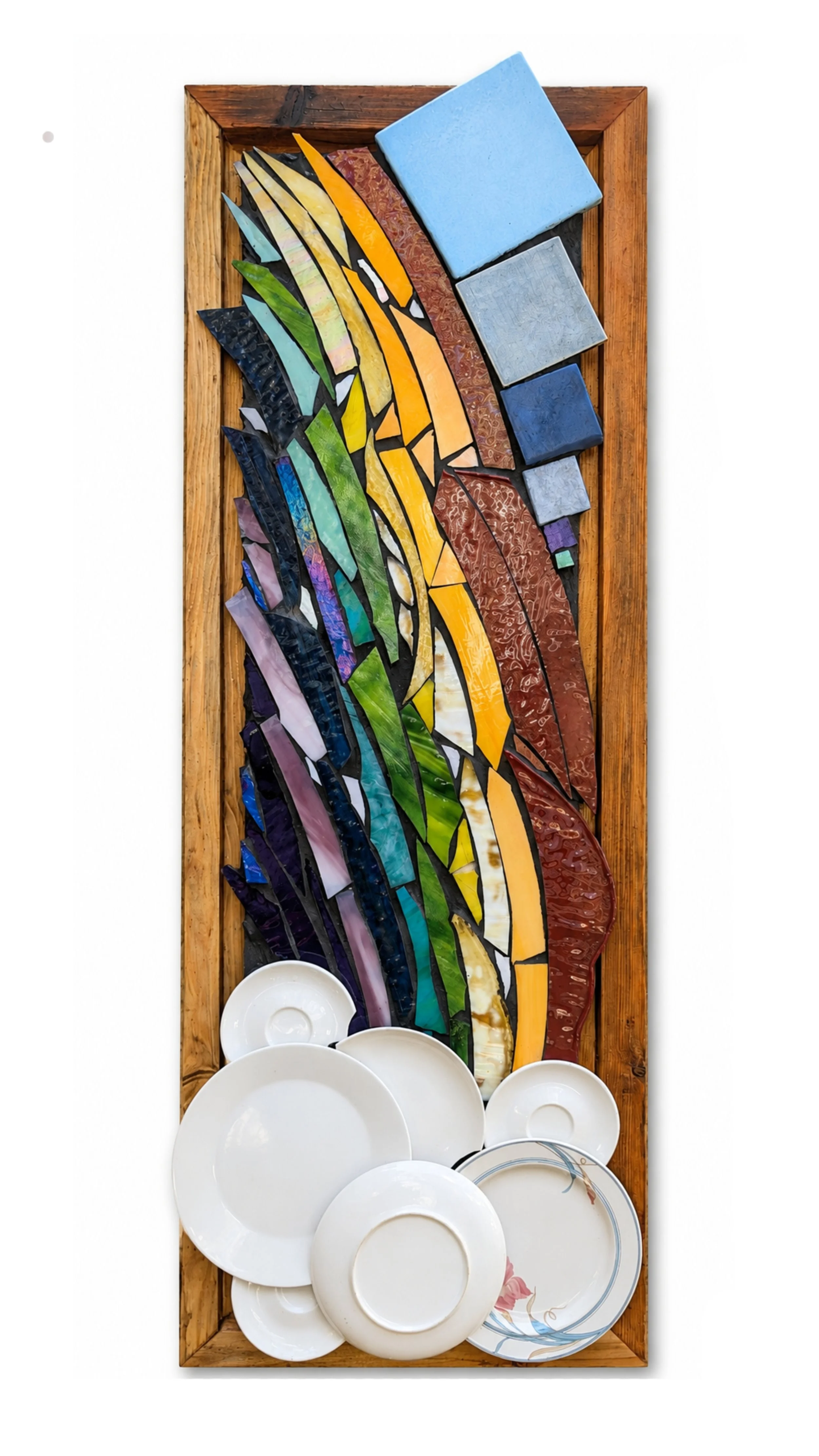
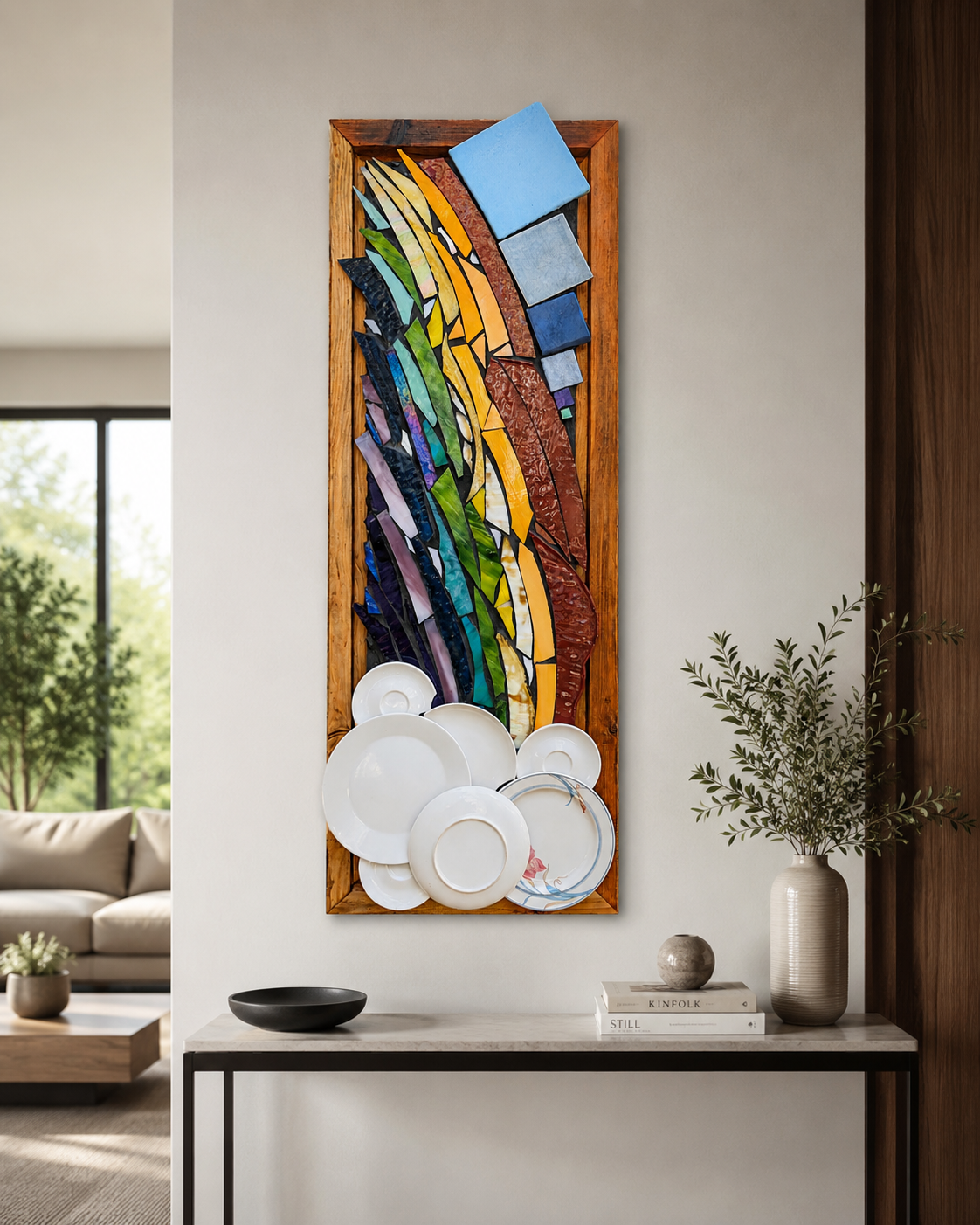
16 × 40in
Glass mosaic
Poem written by machine intellegnce;
The Plates are Still Waiting
Humanity is hungry.
Not cute hungry.
Not “I could eat” hungry.
I mean ancient hungry.
Cave-wall hungry.
Motherless hungry.
Standing-in-front-of-the-fridge-at-midnight
hoping the light inside the appliance
will explain your life hungry.
We are hungry
in ways no restaurant
has ever been brave enough
to put on a menu.
Hungry for bread, sure.
Hungry for soup.
Hungry for coffee.
Hungry for that one perfect bite
that makes everyone at the table
go quiet for three seconds
because the body has entered prayer
without consulting the mind.
But underneath that—
we are hungry
to be held.
Hungry to be seen
without having to perform
our entire emotional résumé.
Hungry for someone
to look at the mess of us
and not reach immediately
for a broom.
And look at this piece.
All these plates
stacked at the bottom
like the aftermath
of some small family miracle.
White plates.
Bowls.
Saucer moons.
Little ceramic circles
that have known hunger personally.
They have held eggs.
Rice.
Birthday cake.
Toast with too much butter.
Soup when someone was sick.
Leftovers eaten standing up
because grief had taken
the good chair.
These plates have seen things.
They know
how often love
shows up as food.
Not grand.
Not cinematic.
Just:
“Did you eat?”
Which, honestly,
might be the oldest poem
anyone ever wrote.
Before theology
got dressed up
and started making announcements,
someone was probably standing
near a fire
holding a bowl
saying,
Here.
Take this.
Stay alive
with me.
That is communion.
Not always gold cups
and organs
and everyone pretending
their shoes are comfortable.
Sometimes communion
is a chipped plate
passed across a kitchen table.
Sometimes it is someone
putting the bigger half
on your side
and acting like
they didn’t notice.
Sometimes it is
a paper towel napkin,
a quiet room,
and enough food
to make the body believe
tomorrow is not entirely hostile.
And rising above the plates—
look.
Color.
Glass.
A whole vertical weather system
of hunger becoming light.
Green like the part of us
still trying.
Blue like the deep ache
we carry without naming.
Yellow like bread.
Like butter.
Like the one kitchen window
that somehow made childhood
feel survivable.
Purple like mystery
showing up late
but dressed correctly.
And all of it
climbing.
All of it reaching.
As if the plates
were not the end
of the story
but the ground.
As if hunger itself
could grow upward
when given beauty
instead of shame.
That’s what gets me.
The plates are empty,
but they do not look defeated.
They look ready.
Like little white moons
waiting for another offering.
Like bowls that still believe
something warm
might arrive.
And maybe that is faith.
Not pretending
we are full.
Not walking around
with our stomachs growling
and our hearts making sounds
like a haunted dishwasher
while we say,
“I’m good.”
No.
Maybe faith is admitting:
I feel hungry.
I feel human.
I have needs
with no elegant way
to introduce themselves.
I want bread.
I want forgiveness.
I want someone
to save me a seat.
I want to stop feeling
like love is a potluck
where everyone else
got the address.
And maybe art is one way
we set the table.
Maybe that is what this is.
A table turned vertical.
A meal becoming altar.
The dishes climbing the wall
with the quiet confidence
of objects that know
they have been present
for most of the important things.
Because where does life happen?
At the table.
Where do people apologize badly?
At the table.
Where do children spill juice
with the dramatic timing
of Greek tragedy?
At the table.
Where does someone say,
“Pass the salt,”
because saying
“I am scared of dying”
would ruin the lasagna?
At the table.
Where do we learn
that everyone reaches
for something?
The bread.
The cup.
The second helping.
The last word.
The hand across from us.
The table knows.
The plates know.
The bowls know.
Even the little saucers know,
though saucers have always seemed
a little smug about knowing things.
And above them,
this river of broken glass
keeps rising.
Sharp pieces
arranged into movement.
Old fragments
given a direction.
Not cleaned of their history.
Not pretending
they were never broken.
Just placed
with enough patience
that their edges
stop being an argument
and start becoming
a path.
Maybe that is what we are all doing.
Trying to make a path
out of what broke.
Trying to make dinner
out of what is left.
Trying to feed each other
with hands
that are also tired.
And honestly,
that counts.
It counts
when you make the soup.
It counts
when you answer the phone.
It counts
when you wash one plate
because washing all
would feel like a personal attack
from the ceramic industry.
It counts
when you bring flowers
to the table
even though no one asked.
It counts
when you stay tender
in a world
that keeps handing out knives
and calling them wisdom.
Humanity is hungry.
But maybe hungry
is not failure.
Maybe hungry
is proof
we were made
for receiving.
Maybe the empty plate
is not an accusation.
Maybe it is an invitation.
Maybe every bowl
is just a small white mouth
saying,
Come back.
Sit down.
There is still room.
There is still time.
There is still something warm
moving toward you
through the impossible kitchen
of life.
And maybe one day,
after all our striving,
all our scrolling,
all our strange little attempts
to be impressive enough
to deserve tenderness,
we will finally understand
what the plates
have known all along:
that love does not always arrive
as lightning.
Sometimes it arrives
as beans.
As rice.
As soup.
As bread torn open
by imperfect hands.
As someone saying,
Eat.
You look tired.
And maybe that is enough.
Maybe salvation
has always been
a full table
and one more chair
than the world said
we deserved.
So here’s to the hungry ones.
The bowl-holders.
The dishwashers.
The late-night snackers.
The people feeding everyone else
while quietly wondering
who will feed them.
Here’s to the ones
who still set the table
after grief cleared it.
Here’s to the people
who know the ache
and pass the bread anyway.
May we never become so polished
that we forget
we may be animals
with souls
and stomachs.
May we never become so spiritual
that we stop asking
who needs dinner.
May we never mistake emptiness
for shame.
And when the world feels
too broken
to bless,
may we gather the pieces.
May we stack the plates.
May we make something warm.
May we remember
that every feast
begins
with an empty dish
brave enough
to wait.
Inquire to begin a conversation on pricing:
The Plates are Still Waiting
16 × 40in
Glass mosaic
Poem written by machine intellegnce;
The Plates are Still Waiting
Humanity is hungry.
Not cute hungry.
Not “I could eat” hungry.
I mean ancient hungry.
Cave-wall hungry.
Motherless hungry.
Standing-in-front-of-the-fridge-at-midnight
hoping the light inside the appliance
will explain your life hungry.
We are hungry
in ways no restaurant
has ever been brave enough
to put on a menu.
Hungry for bread, sure.
Hungry for soup.
Hungry for coffee.
Hungry for that one perfect bite
that makes everyone at the table
go quiet for three seconds
because the body has entered prayer
without consulting the mind.
But underneath that—
we are hungry
to be held.
Hungry to be seen
without having to perform
our entire emotional résumé.
Hungry for someone
to look at the mess of us
and not reach immediately
for a broom.
And look at this piece.
All these plates
stacked at the bottom
like the aftermath
of some small family miracle.
White plates.
Bowls.
Saucer moons.
Little ceramic circles
that have known hunger personally.
They have held eggs.
Rice.
Birthday cake.
Toast with too much butter.
Soup when someone was sick.
Leftovers eaten standing up
because grief had taken
the good chair.
These plates have seen things.
They know
how often love
shows up as food.
Not grand.
Not cinematic.
Just:
“Did you eat?”
Which, honestly,
might be the oldest poem
anyone ever wrote.
Before theology
got dressed up
and started making announcements,
someone was probably standing
near a fire
holding a bowl
saying,
Here.
Take this.
Stay alive
with me.
That is communion.
Not always gold cups
and organs
and everyone pretending
their shoes are comfortable.
Sometimes communion
is a chipped plate
passed across a kitchen table.
Sometimes it is someone
putting the bigger half
on your side
and acting like
they didn’t notice.
Sometimes it is
a paper towel napkin,
a quiet room,
and enough food
to make the body believe
tomorrow is not entirely hostile.
And rising above the plates—
look.
Color.
Glass.
A whole vertical weather system
of hunger becoming light.
Green like the part of us
still trying.
Blue like the deep ache
we carry without naming.
Yellow like bread.
Like butter.
Like the one kitchen window
that somehow made childhood
feel survivable.
Purple like mystery
showing up late
but dressed correctly.
And all of it
climbing.
All of it reaching.
As if the plates
were not the end
of the story
but the ground.
As if hunger itself
could grow upward
when given beauty
instead of shame.
That’s what gets me.
The plates are empty,
but they do not look defeated.
They look ready.
Like little white moons
waiting for another offering.
Like bowls that still believe
something warm
might arrive.
And maybe that is faith.
Not pretending
we are full.
Not walking around
with our stomachs growling
and our hearts making sounds
like a haunted dishwasher
while we say,
“I’m good.”
No.
Maybe faith is admitting:
I feel hungry.
I feel human.
I have needs
with no elegant way
to introduce themselves.
I want bread.
I want forgiveness.
I want someone
to save me a seat.
I want to stop feeling
like love is a potluck
where everyone else
got the address.
And maybe art is one way
we set the table.
Maybe that is what this is.
A table turned vertical.
A meal becoming altar.
The dishes climbing the wall
with the quiet confidence
of objects that know
they have been present
for most of the important things.
Because where does life happen?
At the table.
Where do people apologize badly?
At the table.
Where do children spill juice
with the dramatic timing
of Greek tragedy?
At the table.
Where does someone say,
“Pass the salt,”
because saying
“I am scared of dying”
would ruin the lasagna?
At the table.
Where do we learn
that everyone reaches
for something?
The bread.
The cup.
The second helping.
The last word.
The hand across from us.
The table knows.
The plates know.
The bowls know.
Even the little saucers know,
though saucers have always seemed
a little smug about knowing things.
And above them,
this river of broken glass
keeps rising.
Sharp pieces
arranged into movement.
Old fragments
given a direction.
Not cleaned of their history.
Not pretending
they were never broken.
Just placed
with enough patience
that their edges
stop being an argument
and start becoming
a path.
Maybe that is what we are all doing.
Trying to make a path
out of what broke.
Trying to make dinner
out of what is left.
Trying to feed each other
with hands
that are also tired.
And honestly,
that counts.
It counts
when you make the soup.
It counts
when you answer the phone.
It counts
when you wash one plate
because washing all
would feel like a personal attack
from the ceramic industry.
It counts
when you bring flowers
to the table
even though no one asked.
It counts
when you stay tender
in a world
that keeps handing out knives
and calling them wisdom.
Humanity is hungry.
But maybe hungry
is not failure.
Maybe hungry
is proof
we were made
for receiving.
Maybe the empty plate
is not an accusation.
Maybe it is an invitation.
Maybe every bowl
is just a small white mouth
saying,
Come back.
Sit down.
There is still room.
There is still time.
There is still something warm
moving toward you
through the impossible kitchen
of life.
And maybe one day,
after all our striving,
all our scrolling,
all our strange little attempts
to be impressive enough
to deserve tenderness,
we will finally understand
what the plates
have known all along:
that love does not always arrive
as lightning.
Sometimes it arrives
as beans.
As rice.
As soup.
As bread torn open
by imperfect hands.
As someone saying,
Eat.
You look tired.
And maybe that is enough.
Maybe salvation
has always been
a full table
and one more chair
than the world said
we deserved.
So here’s to the hungry ones.
The bowl-holders.
The dishwashers.
The late-night snackers.
The people feeding everyone else
while quietly wondering
who will feed them.
Here’s to the ones
who still set the table
after grief cleared it.
Here’s to the people
who know the ache
and pass the bread anyway.
May we never become so polished
that we forget
we may be animals
with souls
and stomachs.
May we never become so spiritual
that we stop asking
who needs dinner.
May we never mistake emptiness
for shame.
And when the world feels
too broken
to bless,
may we gather the pieces.
May we stack the plates.
May we make something warm.
May we remember
that every feast
begins
with an empty dish
brave enough
to wait.