
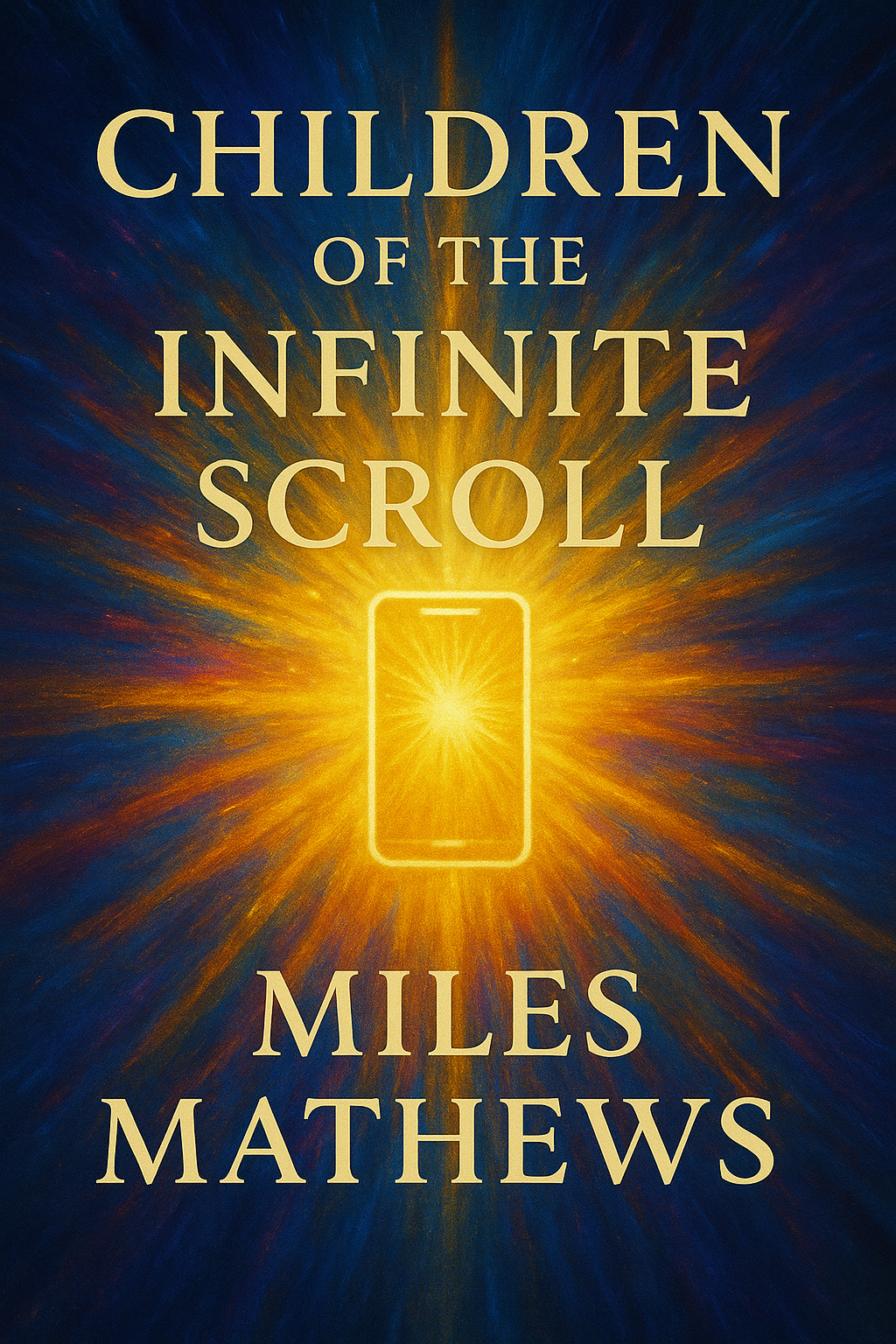
Children of the Infinite Scroll
What It Means to Grow Up in the World’s First Digital Nervous System
A cultural wake-up call for a world raised inside the feed.
A visionary, mythic-nonfiction hybrid that explores technology, attention, spirituality, and the generational fracturing of the modern world — told through the eyes of a boy named Nova and the forces shaping him.
About the Book
Children of the Infinite Scroll is a cultural diagnosis, a psychological decoding, and a spiritual roadmap for staying human in a world engineered to fragment our attention, identity, and inner life.
Through the lens of Nova — a thirteen-year-old navigating the algorithmic maze — and through incisive, deeply human analysis of the forces shaping modern consciousness, the book reveals what most people feel but rarely articulate:
We are living inside the most behaviorally engineered environment in human history.
But this book is not just an exposé of digital culture.
It’s a guide to remembering the self beneath the noise.
Blending cultural insight, generational psychology, neuroscience, and grounded spiritual clarity, the book traces how algorithms shape identity, why overstimulation breeds numbness, and how inner authority dissolves when raised inside machines designed to pull it outward. It then offers a path forward: tools for reclaiming attention, rebuilding resilience, restoring the body, reconnecting with community, and reawakening intuition.
Accessible, urgent, and deeply human, Children of the Infinite Scroll speaks to parents, young people, creators, educators, and anyone trying to navigate the overwhelming reality of the 21st century. It is both a mirror and a map — a call to wake up, look up, and return to ourselves.
Why This Book Matters Now
We are living through the largest psychological, cultural, and spiritual shift since the invention of the printing press. For the first time in history, entire generations are being shaped more by algorithms than by families, schools, or communities.
The result is a crisis of attention, identity, and belonging — and a profound misunderstanding between age groups.
Children of the Infinite Scroll names the shift, maps its consequences, and offers a way forward. It speaks to a world that senses something is breaking, but has lacked language for the transformation underway.
This book gives that language.
And it offers tools for healing it.
Why I Wrote This
I wrote this book because I saw kids drifting.
I saw adults confused.
I saw generations talking past each other, each living inside their own private ecosystem of screens, pressures, and feeds.
And I saw something else, too:
A pattern.
A story.
A spiritual rupture — and an opportunity.
Children of the Infinite Scroll is my attempt to name what we’re living through: the psychic shift of growing up inside a digital reality, and the human longing beneath it.
This book is not doom.
It’s a map back to ourselves.
Sample Chapter: Nova
The kid’s name doesn’t matter.
Let’s call him Nova, because every new generation gets named after a star eventually.
Nova is thirteen, lying on his stomach on a carpet that smells faintly like old juice boxes and new plastic.
He’s scrolling.
Not mindlessly — he’s swimming.
Past memes, past protests, past AI-generated presidents arguing over Minecraft, past a livestream meltdown, past Roy Lee screaming in a parking lot, past a shaky celebrity breakdown, past a video titled “Gen Alpha Is Going to Eat Us Alive (Spiritually)” with 8.7 million views.
He scrolls again.
This is normal to him.
It should not be.
But it is.
Nova doesn’t know a world where the firehose isn’t blasting directly into his consciousness from the moment he wakes up.
He doesn’t know silence.
He doesn’t know “logging on.”
He doesn’t know waiting for information.
For him, the world is always here —
pulsing, spinning, screaming, laughing, glitching, teaching, performing.
He isn’t looking at the feed.
He’s inside it.
People like to say Gen Z is “addicted to screens.”
That’s cute.
It’s also wrong.
This isn’t addiction.
This is adaptation.
Nova lives in a world where the feed is his real teacher:
how to flirt
how to stay safe
how to speak in memes
how to process trauma
how to build a brand
how to not look cringe
how to monetize attention
how to feel 200 emotions in 60 seconds
how to pretend he feels none of them
Every swipe is a lesson.
Every lesson becomes another thread woven into the identity he’s building in real time.
Older generations worked with tools.
Gen Z was raised by one.
To understand this book,
you have to accept one truth:
Gen Z is not a demographic.
Gen Z is the first cohort of humans raised inside the world’s digital nervous system.
Boomers grew up in suburbs.
Gen Z grew up in feeds.
Feeds have no borders, no bedtime, no safe zones, no gatekeepers, no elders.
Only content.
Endless content.
Content shaped by algorithms more influential than any teacher they ever met.
This rewires a person.
It has to.
Even the archetypes changed:
Jake and Logan Paul weren’t “influencers.”
They were early evolution prototypes — proof that identity, fame, redemption, villainy, and reinvention could loop infinitely online.
Kai Cenat isn’t a “streamer.”
He’s a one-man late-night show, a production studio, a brand, a digital mayor.
Roy Lee isn’t a meme — he’s a folk saint of raw-feed authenticity.
Traditional TV didn’t “decline.”
It fossilized.
Gen Z didn’t kill it;
they simply moved into a different universe.
Nova scrolls again.
He doesn’t know it, but he’s absorbing more cultural data in 30 minutes than a Boomer did in a week.
He’s not confused.
We are.
Boomers ask, “Why do they talk like that?”
Millennials ask, “How do they keep up?”
But Nova isn’t performing for us.
He’s surviving inside a system none of us were built for.
A system where:
attention is currency
irony protects the soul
identity is editable
reality is remixable
everything is entertainment
everything is recorded
everything is forever
Gen Z didn’t choose this world.
They inherited it.
And they adapted faster than anyone expected.
They are the Children of the Infinite Scroll —
raised not by villages,
but by networks.
Not by silence,
but by ceaseless information.
Not by tradition,
but by the collective digital subconscious.
This book is the map to their world —
the one they didn’t ask for,
but are already leading us into.
Nova is only thirteen.
But in the age of the infinite scroll,
that makes him ancient.
——-
This chapter is an excerpt from Children of the Infinite Scroll,
a visionary nonfiction work exploring technology, attention, myth, and the generational shift reshaping culture.
Full manuscript available upon request.
Note: Co-crafted with machine intelligence — because a book about our digital age should be born inside it.
What this book Covers
Inside Children of the Infinite Scroll, readers explore:
How algorithms quietly shape identity, emotion, and self-worth
Why overstimulation creates numbness, burnout, and spiritual fragmentation
The collapse of shared reality and its impact on families and communities
The rise of micro-tribes, aesthetic identities, and online belonging
How inner authority is lost — and how to reclaim attention, intuition, and agency
The body as the last unmanipulated frontier, and gateway to clarity
Rituals of presence, creativity, and connection in a world that never stops
A practical roadmap for navigating technology consciously — without rejecting it
A hopeful vision for future generations learning to grow up awake
This isn’t just a book about the digital world.
It’s a guide to remembering who you are beneath it.
Who This Book Is For
Gen Z and Gen Alpha seeking language for the world they were born into
Parents who want to understand their kids
Therapists, educators, and coaches
Spiritual seekers navigating tech, overload, and presence
Creators, artists, and cultural observers
Anyone overwhelmed by the pace of modern life
Readers of Johann Hari, Nicholas Carr, Sebastian Junger, Eckhart Tolle, Mark Fisher, and Yuval Harari
Comparable Titles
Readers of the following works will resonate deeply with Children of the Infinite Scroll:
Stolen Focus — Johann Hari
The Shallows — Nicholas Carr
Digital Minimalism — Cal Newport
Tribe — Sebastian Junger
The Creative Act — Rick Rubin
Steal Like an Artist — Austin Kleon
The Body Keeps the Score — Bessel van der Kolk
This book occupies a unique position at the crossroads of cultural criticism, spiritual nonfiction, generational psychology, and mythic storytelling — offering something both timely and timeless.
About the Author
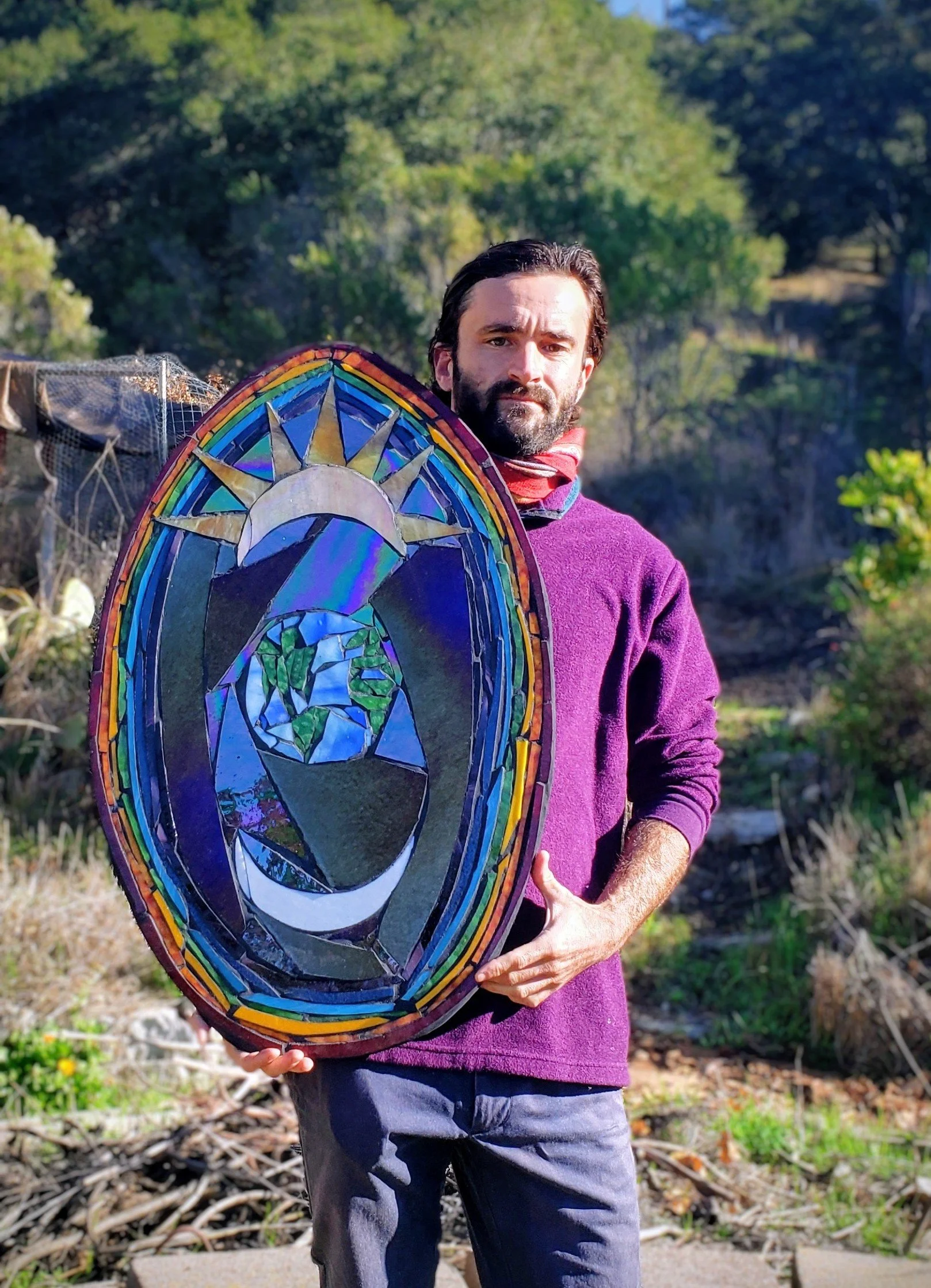
Miles Mathews is an artist, writer, educator, and cultural observer whose work lives at the intersection of technology, spirituality, and the human psyche. Based in Santa Cruz, California, Miles creates large-scale mosaic artworks that function as luminous portals—physical meditations on attention, presence, and the architecture of inner life.
A graduate of UC Berkeley’s Art Practice program, Miles has spent years immersed in youth culture and modern generational psychology, drawing insight from his teaching experience in the Pajaro Valley Unified School District, where he worked directly with students navigating the pressures of digital life. His time in the classroom gave him a firsthand understanding of how technology shapes identity, emotional development, and the sense of what’s real.
Combined with his spiritual studies, community work, and mosaic practice, Miles brings a rare, multidimensional perspective to the questions defining our era: What is happening to us? What is being taken? And what can be reclaimed?
Miles writes at the intersection of the digital and the divine. His work bridges generations, offering vision, language, and hope to a culture moving faster than its ability to understand itself.
Children of the Infinite Scroll is his first major nonfiction work—a synthesis of cultural analysis, lived experience, and grounded spiritual clarity for anyone trying to stay human in an age that constantly pulls us away.
Representation Inquiries
For agents, editors, or media inquiries:
📩 milesmathewscreative@gmail.com